How Much Money Should I Save Before Buying a House in Colorado Springs?
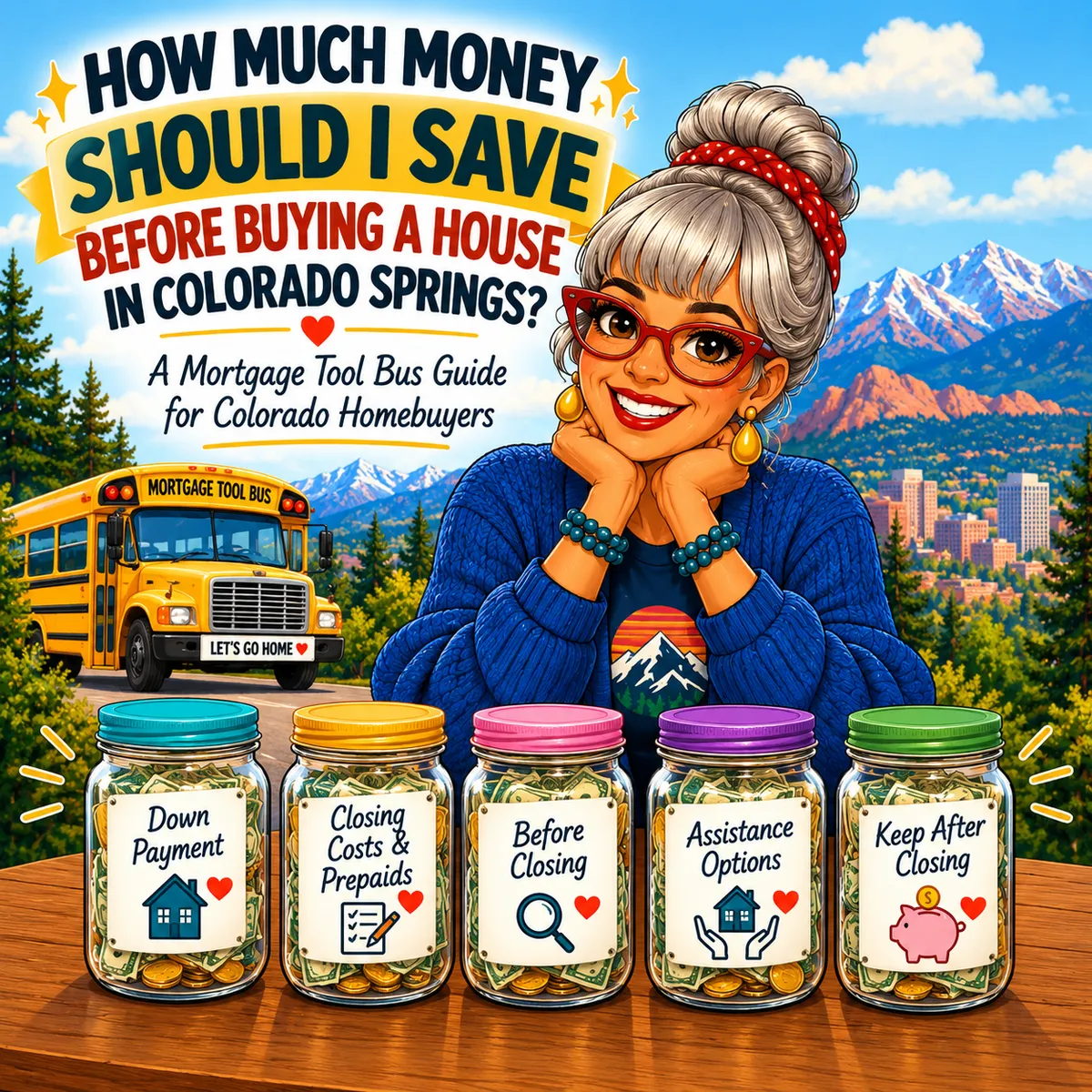
How Much Money Should I Save Before Buying a House in Colorado Springs?
A Mortgage Tool Bus Guide for Colorado Homebuyers
🚌 Stop #1: Start With the Down Payment
This is usually the number people think about first.
And it's also where I hear one of the biggest homebuyer myths:
“I need 20% down.”
You may not.
Depending on the loan and your qualifications, options can include:
VA financing with potentially 0% down for eligible borrowers
USDA financing with potentially 0% down for eligible borrowers and properties
FHA financing with down payments starting at 3.5% for qualifying borrowers
Conventional options that may start at 3% for some eligible buyers
Twenty percent can absolutely be a great goal. A larger down payment can affect your loan amount, monthly payment, mortgage insurance, and overall financing.
But 20% is not automatically the admission price for homeownership.
And this is where I want to separate two questions:
“How much am I required to put down?”
and
“How much do I WANT to put down?”
Those aren't always the same answer.
I would rather look at your full financial picture than automatically take every dollar you have and throw it at the down payment.
🚌 Stop #2: Don't Forget Closing Costs and Prepaids
Your down payment isn't your entire cash-to-close number.
There can also be closing costs and prepaid expenses associated with buying the home and setting up the mortgage.
These can include things such as:
Lender and loan costs
Appraisal
Title-related costs
Recording or government fees
Homeowners insurance
Property tax escrows
Prepaid interest
Initial escrow deposits
A rough planning estimate for closing costs is often around 2% to 5% of the home's purchase price, separate from the down payment.
But please don't turn that into:
“Kat said my closing costs WILL be 5%.” 😆
They vary.
Your home price, loan program, lender, insurance, taxes, closing date, and transaction all affect the final number.
That's why I like estimates for planning — and actual loan disclosures for decision-making.
🚌 Stop #3: Some Expenses Happen Before Closing Day
This is another piece first-time buyers don't always expect.
Not every expense waits until closing.
Depending on your purchase and your contract, you may encounter expenses along the way such as:
Earnest Money
Earnest money is money you put down after going under contract to show the seller you're serious about the purchase.
The amount is negotiated as part of the contract.
If the transaction closes normally, earnest money is generally credited toward what you owe in the transaction — it isn't just an extra pile of money that disappears.
But you may need to have it available earlier in the process.
Home Inspection
A home inspection is optional in the sense that your lender generally isn't requiring you to inspect the house, but I am a big fan of buyers understanding what they're buying.
Inspection fees are commonly paid during the contract period rather than waiting for closing day.
Appraisal
If your loan requires an appraisal, that cost may also be collected before closing depending on how the lender handles it.
The takeaway?
You may need some accessible money before the day you receive your keys.
🚌 Stop #4: Assistance Can Change the Math
This is where the conversation gets interesting.
If savings are the piece making homeownership feel impossible, there may be programs worth researching before you decide you can't buy.
For Colorado buyers, one program I frequently discuss is CHFA — the Colorado Housing and Finance Authority.
CHFA has mortgage programs that can be paired with assistance for eligible borrowers to help with down payment and/or closing costs.
There are requirements, income limits, program rules, and tradeoffs to review, so “there's assistance available” does not mean “free money for everyone.”
But it DOES mean we should check.
Depending on the borrower's situation, there may also be other down payment assistance programs available, including options such as Chenoa Fund.
This is one reason I don't want someone deciding they're five years away from homeownership based on a savings number they found on Google.
Let's look at the actual options first.
Want the deeper CHFA explanation?
Read my Colorado down payment assistance guide here:
https://mortgagetoolbus.com/post/chfa-down-payment-assistance-colorado
🚌 Stop #5: The Seller May Be Able to Help With Some Costs
Here's another variable that can change your cash-to-close number:
Seller concessions.
Depending on the loan program, purchase contract, appraisal and market conditions, a seller may agree to contribute toward certain buyer closing costs.
That doesn't mean the seller is paying your down payment.
And it doesn't mean buyers should automatically expect seller concessions on every house.
But in a market where sellers are negotiating — especially when a home has been sitting longer or the seller has another reason to make the deal work — concessions can be part of the conversation.
Those credits may potentially help with allowable costs such as closing expenses, prepaids or, depending on the transaction, interest-rate buydowns.
There are limits based on the loan program and transaction.
This is where having the lender and real estate agent communicating EARLY can be really helpful.
If we know you have enough money for the down payment but closing costs are the pain point, your agent can understand that before writing the offer.
That's much better than discovering the problem three days before closing.
🚌 Stop #6: Please Don't Forget the Money You Need AFTER Closing
This may be the most important stop in this article.
I always encourage people to save as much as reasonably possible.
Not because I expect you to put all of it into the house.
Quite the opposite.
Homes have a funny sense of humor.
You move in and suddenly discover:
The shower curtain doesn't fit.
The lawn mower died.
You need blinds.
The dog has figured out the fence has a weak spot.
And somehow you own 14 trips' worth of Home Depot receipts. 😂
I don't want to structure a purchase where getting the keys leaves you scared of the first unexpected expense.
Your comfort level matters.
For one buyer, having $3,000 left after closing may feel okay.
Another person may not feel comfortable unless they still have several months of expenses saved.
Neither person is wrong.
This is YOUR financial life.
🚌 So…Is $15,000 Enough?
Maybe.
And I actually think this is a much more useful question than asking whether $15,000 is “a lot” of savings.
Imagine two buyers both have $15,000.
Buyer A may qualify for a 0%-down loan and negotiate some seller concessions.
Buyer B may be using a loan requiring a down payment, buying a property where the seller isn't contributing toward costs, and want to preserve $5,000 after closing.
Same savings account.
Completely different math.
That's why I don't want to turn savings into a generic chart that says:
$10,000 = this house
$15,000 = that house
$20,000 = bigger house
Mortgages don't work that neatly.
But we absolutely CAN run scenarios.
And that's where this starts becoming useful.
Frequently Asked Questions
How much should I save before buying a house in Colorado?
There isn't one required savings amount for every buyer. Your number depends on your down payment, closing costs, loan program, purchase price, available assistance, seller credits, transaction expenses and how much savings you'd like to preserve after closing.
Do I need 20% down to buy a house?
No. Several mortgage programs allow qualified buyers to purchase with substantially less than 20% down, and some eligible VA and USDA buyers may have a 0%-down option.
How much should I estimate for closing costs?
A common early planning estimate is approximately 2% to 5% of the purchase price, separate from your down payment. Your actual costs will depend on the specific loan and transaction.
Does earnest money count toward my closing costs?
Earnest money is typically credited as part of the transaction if the purchase closes, rather than being an additional cost on top of everything else. The amount and terms are established in the purchase contract.
Can a seller pay my closing costs?
A seller may agree to contribute toward certain allowable costs. The amount and allowable uses depend on your loan program, contract, transaction and applicable limits.
Can down payment assistance help with closing costs too?
Some programs can. For example, certain CHFA assistance can be used toward eligible down payment and/or closing costs. Program requirements apply, so it's worth reviewing your specific eligibility rather than assuming you qualify — or assuming you don't.
Should I use all of my savings to buy a house?
I generally don't want buyers draining every dollar just to reach closing day. We can look at your options, your required cash to close and the amount you personally want to keep as a financial cushion.
❤️ Let’s Go Home
— Kat Fish
Mortgage Tool Bus
NMLS #2609071