
Can I Use My VA Loan Twice? | El Paso County Guide
Can I Use My VA Loan Twice If I Still Own My First Home?
A Mortgage Tool Bus Guide for PCS Families in El Paso County
🚌 Stop 1: What “Entitlement” Actually Means
Your VA entitlement isn't a stack of cash sitting in an account with your name on it. It's a promise the VA makes to your lender: if you can't make your payments, the VA will cover a percentage of the loss.
That guarantee is what lets you buy with $0 down in the first place, and it's also what makes a second VA loan possible while you still own your first home. Nothing about entitlement requires you to sell anything — it's the size of the VA's promise that determines what you can do next, not your address history.
🚌 Stop 2: The Two Tiers — Basic and Bonus
VA entitlement comes in two tiers. Basic entitlement — sometimes called tier 1 — is $36,000, and it covers loans up to $144,000.
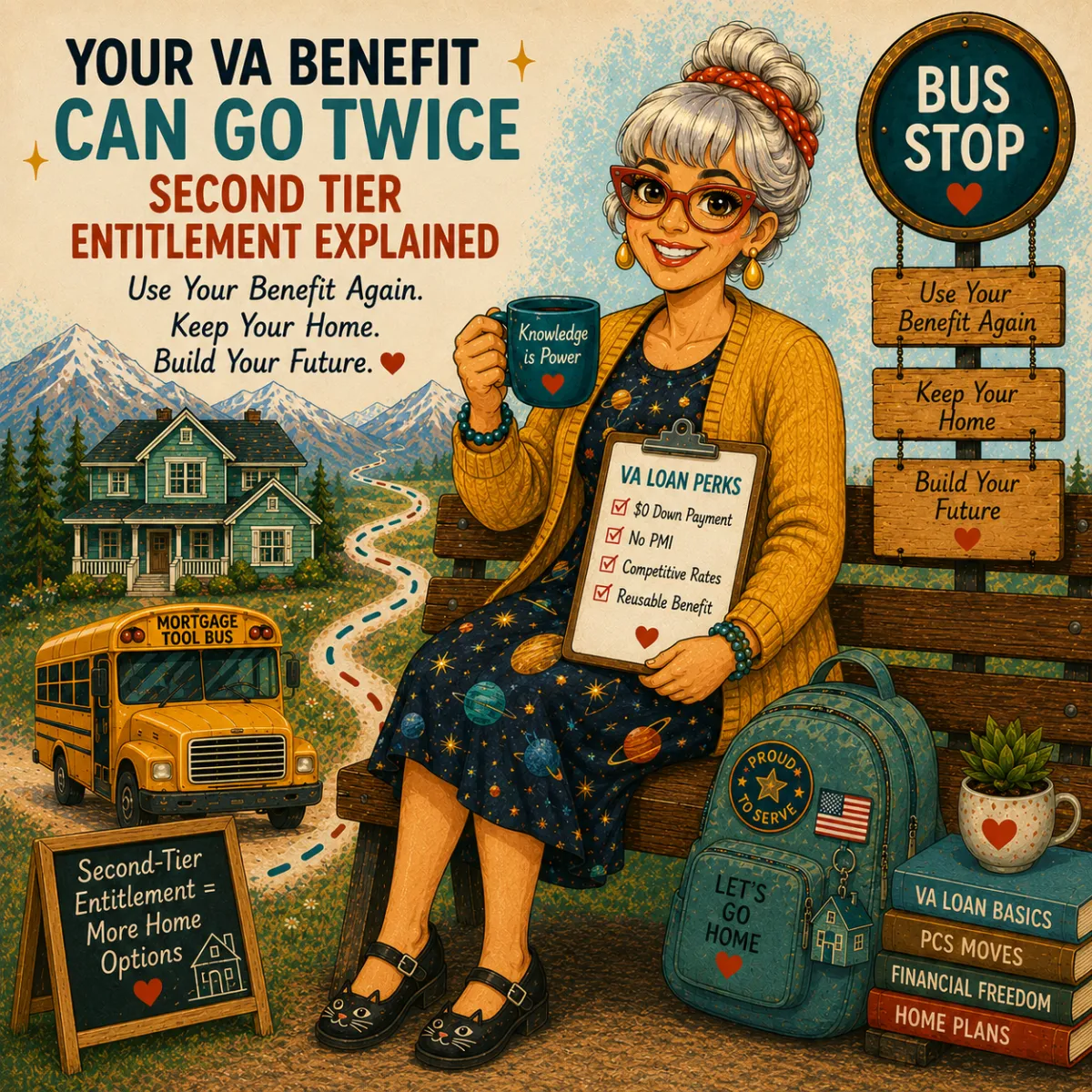
Most homes today cost more than that, which is where bonus entitlement (also called tier 2 or second-tier entitlement) comes in. For any loan over $144,000, the VA guarantees up to 25% of the loan amount instead of a flat dollar figure.
If you have full entitlement — meaning you've never used your VA loan, or you paid off a prior VA loan and had it fully restored — there's no VA-imposed loan limit at all, as long as your lender approves you and the appraisal supports the price.
🚌 Stop 3: The PCS Scenario — Keeping Your First Home as a Rental
Here's the scenario we see all the time around Fort Carson, Peterson Space Force Base, and Schriever: PCS orders come in, and instead of selling the first home, the family decides to keep it and rent it out.
The good news is the VA doesn't require you to sell in order to use your loan benefit again. What matters is whether you have enough remaining entitlement to back the new loan — or whether you're willing and able to cover the difference with a down payment.
Your lender will also look at how the rental income and the mortgage on the first home affect what you qualify for on the new one, so this is a conversation worth having early, ideally as soon as orders drop.
🚌 Stop 4: How to Calculate Your Remaining Bonus Entitlement
Because bonus entitlement isn't printed on your Certificate of Eligibility, you (or your lender) have to calculate it. Here's the math, straight from the VA:
Find the “Entitlement Charged” amount on your COE — this is what's already tied up in your current VA loan.
Look up your county's one-unit conforming loan limit. For El Paso County in 2026, that's $832,750.
Multiply the county loan limit by 25%.
Subtract the entitlement already charged. What's left is your remaining bonus entitlement.
Say you have $50,000 charged against your entitlement from your first home. In El Paso County, $832,750 × 25% = $208,187.50. Subtract the $50,000 already used, and you're left with $158,187.50 in remaining bonus entitlement.
Most lenders will loan up to four times your remaining entitlement without requiring a down payment, so that's roughly a $632,750 zero-down ceiling — before your lender applies their own income, credit, and debt requirements. This is an example, not your number. Your lender will run your actual figures from your COE.
🚌 Stop 5: What This Means for Your Down Payment (and Funding Fee)
If your remaining entitlement doesn't stretch far enough to cover 25% of the new loan amount, that gap doesn't have to be a dealbreaker — you can often bridge it with a down payment, and your lender can walk you through exactly how much.
It's also worth knowing that a second use of your VA loan can come with a different funding fee than your first purchase, unless you qualify for one of the funding fee exemptions. We cover exactly how that works in our VA funding fee guide, so use that alongside this post when you're running your numbers.
Helpful Tools & Related Reads
VA Loan Basics: mortgagetoolbus.com/va-loan
Does BAH Count as Income for a Mortgage?: mortgagetoolbus.com/post/does-bah-count-as-income-for-a-mortgage
VA Funding Fee Guide: mortgagetoolbus.com/post/what-is-the-va-funding-fee
Military PCS Homebuyer Guide: mortgagetoolbus.com/military-pcs-homebuyer-guide
Frequently Asked Questions
Do I have to sell my first home before I can use my VA loan again?
No. As long as you have enough remaining entitlement — or can cover the gap with a down payment — you can keep your original home, even as a rental, and use your VA benefit on a new purchase.
What's El Paso County's VA loan limit for 2026?
El Paso County follows the FHFA one-unit conforming loan limit, which is $832,750 for 2026. That's the number used to calculate your remaining bonus entitlement if you don't have full entitlement.
Will my funding fee be different the second time I use my VA loan?
Possibly. VA funding fees can be higher on a subsequent use unless you qualify for one of the funding fee exemptions. Check our VA funding fee guide for the specifics before you run your numbers.
Can I restore my full entitlement instead of using bonus entitlement?
In some cases — for example, if you've sold the home tied to your existing VA loan or paid it off in full. A one-time restoration option can also apply if you still own the home. Talk with your lender or the VA directly about which option fits your situation.
Does my Certificate of Eligibility show my bonus entitlement amount?
No. The VA doesn't list bonus entitlement on your COE — it has to be calculated using your county's loan limit and the amount already charged against your entitlement.
❤️ Let’s Go Home
— Kat Fish
Mortgage Tool Bus
NMLS #2609071