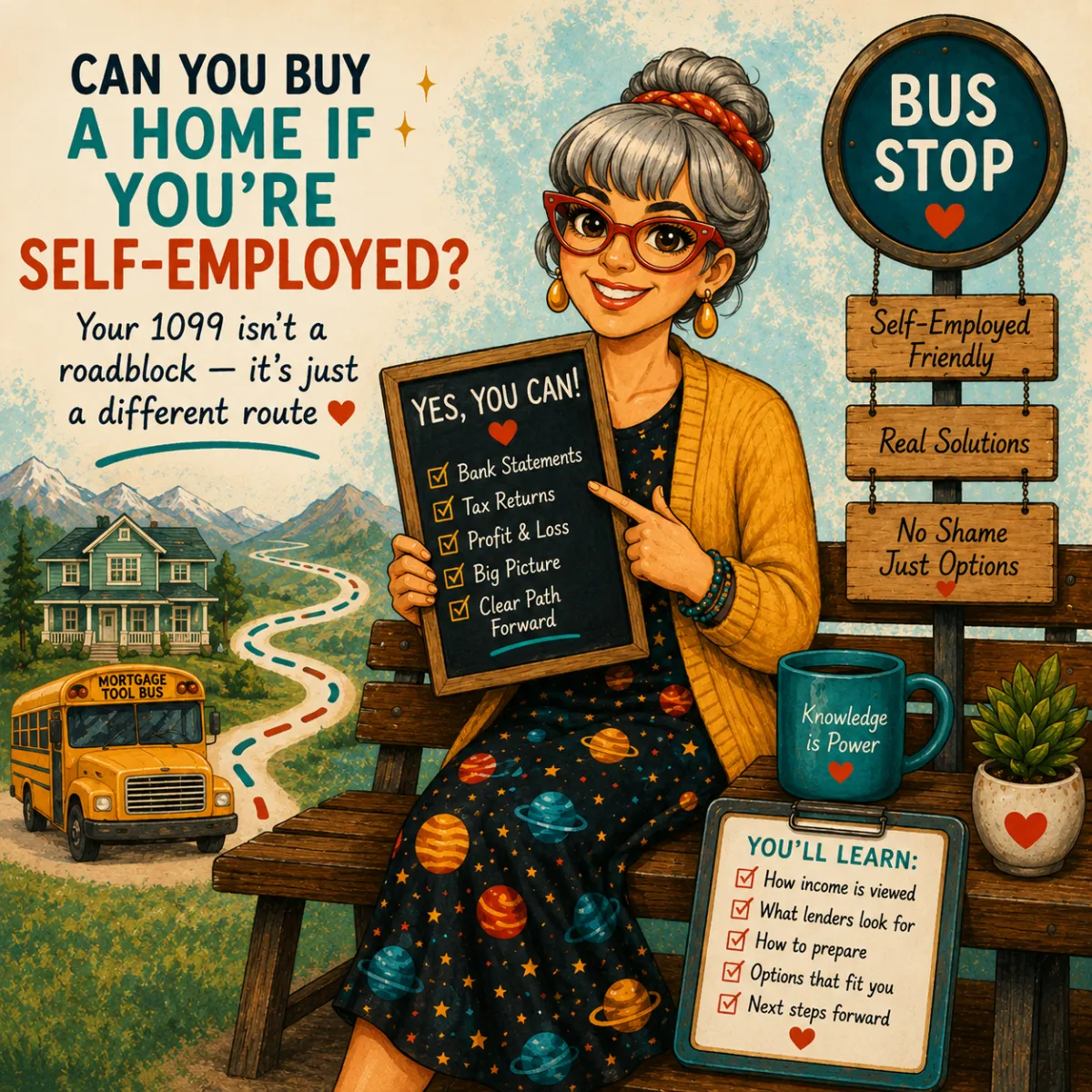
Can You Buy a Home If You're Self-Employed?
Can You Buy a Home If You're Self-Employed?
A Mortgage Tool Bus Guide for Colorado Homebuyers
Your 1099 isn't a roadblock — it's just a different route
Being self-employed changes what documents a lender needs — it doesn't change whether you can qualify. Here's how it actually works, stop by stop.
🚌 Stop #1: How Lenders Actually Read Your Income
Per Fannie Mae's Selling Guide, if you own 25% or more of a business, you're considered self-employed for mortgage purposes — whether that's a sole proprietorship, an S-corp, or a minority stake in a partnership. The standard ask is two years of signed personal and business federal tax returns, which your lender runs through a cash flow analysis (Fannie Mae Form 1084 or an equivalent) to turn your tax return into a monthly qualifying income number. If you've been self-employed less than two years but at least one full year in the same field, that income may still count — and if you've owned 25%+ of the business for five years or more, Fannie Mae allows qualifying off just one year of tax returns instead of two.
🚌 Stop #2: The Write-Off Paradox
This is the part that trips up a lot of business owners: the same deductions your CPA uses to lower your tax bill also lower the income a lender can count toward qualifying. A strong write-off strategy is good for April and can work against you in a mortgage application, because underwriting looks at net income after those deductions, not what actually hit your bank account. If a home purchase is somewhere in your next year or two, it's worth a conversation with your loan officer before you file — not after — so you understand the trade-off you're making.
🚌 Stop #3: Bank Statement Loans
If your tax returns understate your real cash flow, a bank statement loan is one alternative worth knowing about. Instead of tax returns, the lender reviews 12 to 24 months of business (or personal) bank deposits to estimate your income directly from what actually came in. These are non-QM, or portfolio, loan products — meaning they aren't backed by Fannie Mae, Freddie Mac, FHA, or VA, so the exact rules, rates, and minimum credit scores are set by each individual lender rather than a single federal guideline. They typically carry a rate premium over a standard conventional loan, but for a business owner whose deposits tell a stronger story than their Schedule C, that trade-off can be worth it.
🚌 Stop #4: DSCR Loans (for Investment Property)
A DSCR loan — Debt Service Coverage Ratio — is a different tool for a different job: it's used to purchase or refinance a rental property, not a primary residence. Instead of looking at your personal income at all, the lender compares the property's expected rental income to its own monthly debt
payment (principal, interest, taxes, insurance, and HOA if applicable). A DSCR of 1.0 means the rent exactly covers the payment; most lenders want to see 1.0 to 1.25 or higher. No tax returns, no personal income documentation — the property has to make its own case.
🚌 Stop #5: What You'll Need, No Matter Which Route You Take
Regardless of which loan type fits your situation, expect to provide proof your business is real and ongoing — an EIN confirmation letter, business license, or partnership agreement — along with year-to-date profit and loss statements and recent business bank statements. The specific list depends on your business structure (sole proprietor, S-corp, partnership) and which loan program you and your loan officer land on.
Helpful Tools
DSCR Loans: mortgagetoolbus.com/dscr-loan
Conventional Loans: mortgagetoolbus.com/conventional-loan
FHA Loans: mortgagetoolbus.com/fha-loan
Monthly Payment Tool: mortgagetoolbus.com/monthlypaymenttool
FAQ
Do I need two full years of self-employment to qualify for a mortgage?
Usually, yes — Fannie Mae generally requires two years of tax returns for self-employed income. There are exceptions: if you've been self-employed less than two years but have at least a full year in the same field, that income may still count, and if you've owned 25% or more of the business for five years or longer, you may qualify with just one year of tax returns.
Will my business write-offs hurt my ability to qualify for a home loan?
They can. Lenders qualify you off your net income after deductions, not your gross revenue, so aggressive write-offs that lower your tax bill can also lower the income a lender counts. Talk to your loan officer before your next tax filing if a home purchase is on your near-term horizon.
What's the difference between a bank statement loan and a DSCR loan?
A bank statement loan is for buying a primary residence (or other owner-occupied property) using your personal or business deposits instead of tax returns to show income. A DSCR loan is specifically for investment property and doesn't look at your personal income at all — it qualifies based on whether the property's rental income covers its own mortgage payment.
I'm a self-employed business owner in Colorado Springs — where do I even start?
Start with your two most recent years of tax returns and a rough sense of what you'd want to put down. From there, a Clarity Call is the easiest first step — we'll look at your actual numbers together and figure out which loan path fits how your business income actually shows up, before you make any decisions.
❤️ Let’s Go Home
— Kat Fish
Mortgage Tool Bus
NMLS #2609071